- 13/10/2026
- Dr. Sumit Chaudhari
- 0 Comments
- Urology
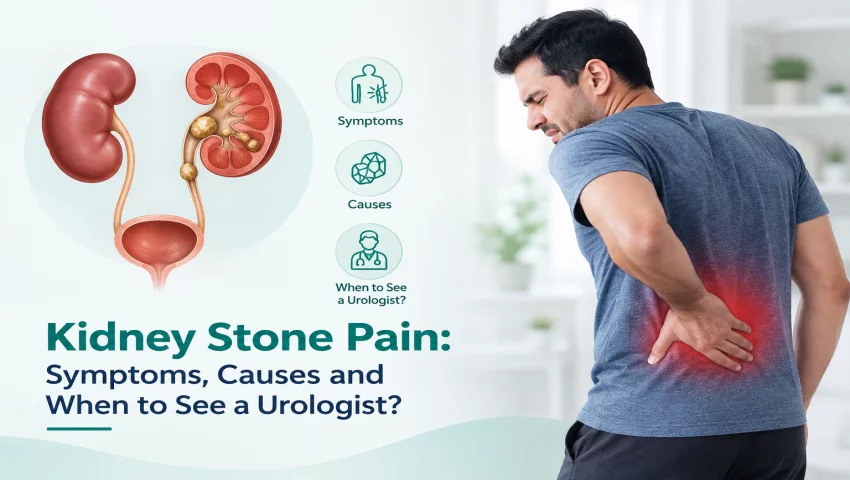
Kidney Stone Pain: Symptoms, Causes and When to See a Urologist?
Kidney stones are a common urinary problem that can cause sudden and sometimes severe pain. While some small stones may pass naturally, others can become stuck in the urinary tract and require medical treatment.
Understanding the symptoms of kidney stones and knowing when to consult a urologist can help prevent complications such as urinary obstruction or infection.
What Are Kidney Stones?
Kidney stones are hard deposits that form when certain minerals and salts in the urine become concentrated and crystallise.
Stones may remain inside the kidney without causing symptoms. Problems often begin when a stone moves from the kidney into the ureter, the narrow tube carrying urine from the kidney to the bladder.
Depending on its size and location, the stone may partially or completely block urine flow.
What Does Kidney Stone Pain Feel Like?
Kidney stone pain can be intense and may begin suddenly.
Common features include:
- Severe pain in the side or back
- Pain below the ribs
- Pain travelling towards the lower abdomen or groin
- Pain that comes in waves
- Restlessness because it is difficult to find a comfortable position
The location of pain may change as the stone moves through the urinary tract.
Other Symptoms of Kidney Stones:
Kidney stones may also cause:
- Blood in the urine
- Burning while passing urine
- Frequent urge to urinate
- Passing small amounts of urine
- Nausea or vomiting
- Cloudy or strong-smelling urine
Some kidney stones cause no symptoms and are detected during an ultrasound or CT scan performed for another reason.
What Causes Kidney Stones?
Kidney stones can develop due to several factors.
Common risk factors include:
- Not drinking enough water
- Recurrent dehydration
- Previous history of kidney stones
- Family history of stones
- Certain dietary patterns
- High levels of calcium, oxalate or uric acid in the urine
- Certain metabolic disorders
- Recurrent urinary infections
- Some medicines
Patients who repeatedly develop stones may require additional evaluation to identify underlying risk factors.
Can Kidney Stones Pass Naturally?
Some small stones can pass through the urinary tract without surgery.
Whether a stone is likely to pass depends on factors such as:
- Stone size
- Location
- Urinary anatomy
- Degree of obstruction
- Patient’s symptoms
The urologist may recommend medicines, adequate hydration and follow-up imaging in suitable patients.
However, waiting for a stone to pass is not appropriate in every case.
When Should You See a Urologist?
You should consider urological evaluation if you have:
- Severe or recurrent pain in the side or back
- Blood in urine
- Persistent difficulty urinating
- Recurrent kidney stones
- A stone detected on ultrasound or CT scan
- Repeated urinary infections
- Pain that does not improve
When Is Kidney Stone Pain an Emergency?
Seek urgent medical attention if stone symptoms are associated with:
- Fever
- Chills
- Severe weakness
- Persistent vomiting
- Inability to pass urine
- Severe uncontrolled pain
Fever associated with urinary obstruction can indicate infection and needs prompt medical assessment.
How Are Kidney Stones Diagnosed?
Depending on the patient’s symptoms, evaluation may include:
- Urine examination
- Blood tests
- Kidney function tests
- Ultrasound
- X-ray
- CT scan
Imaging helps determine the number, size and location of stones and whether the urinary tract is blocked.
Kidney Stone Treatment Options:
Treatment depends on the stone rather than using the same procedure for every patient.
- Medicines and Observation: Small stones that are likely to pass may sometimes be managed with medicines and monitoring.
- URSL: Ureteroscopic Lithotripsy is commonly used for stones located within the ureter.
- RIRS: Retrograde Intrarenal Surgery uses a flexible scope to reach and treat selected kidney stones through the natural urinary tract.
- PCNL: Percutaneous Nephrolithotomy may be considered for selected larger or complex kidney stones.
A urologist decides which approach is appropriate after reviewing the scans and the patient’s clinical condition.
Can Kidney Stones Come Back?
Yes. Patients who have developed one kidney stone may develop another in the future.
General preventive measures may include:
- Drinking adequate fluids
- Avoiding repeated dehydration
- Reducing excessive salt intake
- Following individual dietary advice
- Managing underlying metabolic conditions
- Treating recurrent urinary infections
Patients with recurrent stones may require blood, urine or stone-analysis investigations.
Kidney Stone Treatment in Pimple Saudagar, Pune:
Dr. Sumit Chaudhari is a Consultant Urologist with expertise in Endourology and kidney stone procedures including RIRS, URSL and PCNL.
Patients experiencing kidney stone symptoms can consult him at Usha Urology & Andrology Clinic in Pimple Saudagar, Pune, for evaluation and treatment planning.
Frequently Asked Questions:
Yes. Stones can irritate the urinary tract and cause visible or microscopic blood in urine.
A stone causing prolonged obstruction, particularly when associated with infection, can affect kidney function.
No. Some stones can pass naturally, while larger, obstructing or complicated stones may require a procedure.
A urologist evaluates and treats kidney and urinary tract stones.